



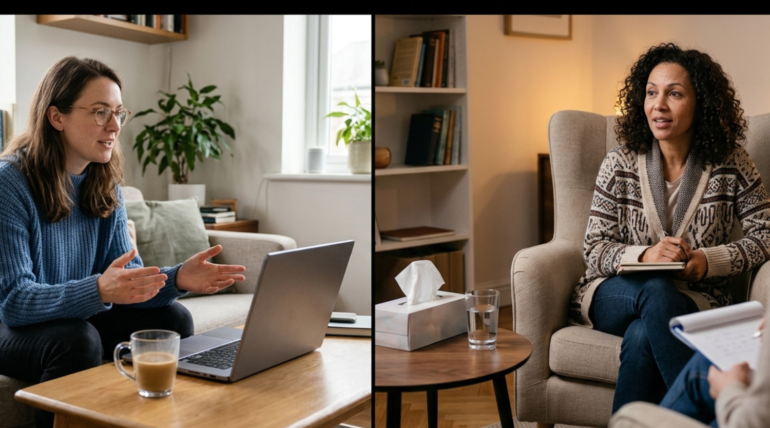
For most of therapy’s history, “going to therapy” meant physically going somewhere. That’s no longer the only credible option, and the research on it is more settled than most people realize. This isn’t a pandemic-era stopgap still being tested; it’s a well-studied treatment format.
What the Research Actually Shows
A 2022 meta-analysis of randomized clinical trials, published in Clinical Psychology: Science and Practice, compared synchronous video-based teletherapy directly against in-person therapy and found no meaningful difference in treatment outcomes between the two formats. This aligns with a broader body of research: studies on video- and phone-delivered CBT for depression, anxiety, and PTSD have consistently found comparable symptom improvement whether therapy happens in an office or over video.
There are a few nuances worth knowing:
- Attendance tends to be higher with teletherapy — fewer missed or canceled sessions when there’s no commute or childcare logistics involved.
- Client demographics differ somewhat between formats. Some research has found teletherapy clients are more likely to be balancing competing demands (work, caregiving, transportation limits) that make in-person appointments harder to sustain consistently.
- Group and intensive formats hold up too — comparative studies of telehealth-delivered group therapy programs have found outcomes similar to in-person group formats, not just for individual sessions.
None of this means teletherapy is “better” across the board; it means the format itself isn’t the deciding factor in whether therapy works. What matters more is fit: the right therapist, the right approach, and consistency.
Where the Two Formats Genuinely Differ
Teletherapy tends to work better when:
- Your schedule makes a commute to an office difficult to sustain weekly
- You have mobility limitations, live rurally, or are managing childcare during the day
- You feel more comfortable opening up from a familiar, private space
- You’re managing symptoms (like social anxiety or agoraphobia) where the drive or waiting room itself is a barrier
In-person therapy tends to work better when:
- You’re working through something that benefits from being fully away from your home environment
- Your home doesn’t offer reliable privacy for a session
- You’re doing certain trauma-focused or somatic work where in-person presence supports the process
- You simply focus better without the distractions or connectivity issues that come with video calls
The Licensure Detail Most People Don’t Know About
One practical detail that surprises a lot of clients: your therapist has to be licensed in the state you’re physically located in at the time of the session, not the state where your therapist’s office is. In Texas, this means a Texas-licensed therapist can see you by video while you’re in Texas, but that same session isn’t automatically valid if you’re traveling out of state when it happens. If you move, or travel for extended periods, it’s worth checking with your provider on how that affects continuity of care; some arrangements allow a short transition window, but it varies.
This is also why “which state is your therapist licensed in” is a reasonable question to ask before starting teletherapy anywhere, not just at HerSpace.
What About Psychiatric Care Specifically?
Telepsychiatry, psychiatric evaluation, and medication management delivered by video have their own body of supporting research and are widely used for ongoing medication management once an initial relationship is established. Certain controlled substances have additional federal requirements around in-person evaluation at some point in care, so if medication management is part of your treatment plan, it’s worth asking your provider directly how that applies to your specific situation.
How to Decide
There’s no universally correct answer; the better question is which format you’ll actually be consistent with. Therapy that happens reliably, in a format you’ll show up for, outperforms an “ideal” format you keep rescheduling around. Many clients also find a hybrid approach works well: starting in person to build rapport, then shifting to video for ongoing sessions, or vice versa, depending on what a given week requires.
Not sure which format fits your life right now? Reach out to HerSpace Mental Wellness — we offer both in-person and telehealth appointments across our services, so you can choose what actually works, not just what’s available.