



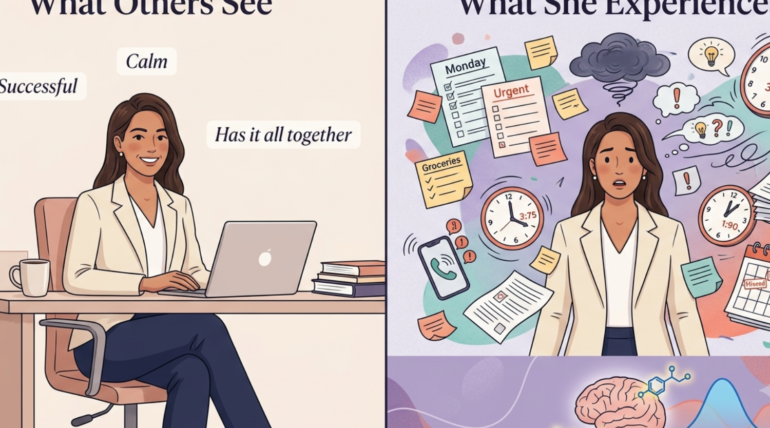
For a long time, ADHD was pictured as a hyperactive little boy who couldn’t sit still. That outdated image left countless women behind.
If you’ve spent years feeling like you’re working twice as hard just to keep up, losing track of time, drowning in half-finished tasks, or constantly criticizing yourself for being “disorganized” or “too much”, you’re not alone, and you’re not failing. You may be one of the many women whose ADHD simply went unrecognized.
At HerSpace Mental Wellness in San Antonio, we hear this story often. Understanding how ADHD presents in women is the first step toward finding clarity, self-compassion, and an effective treatment plan.
Why ADHD in Women Often Goes Undiagnosed
For decades, ADHD research focused primarily on boys. As a result, many girls with ADHD were overlooked during childhood.
Although boys are diagnosed with ADHD more frequently during childhood, the gap narrows considerably in adulthood. This strongly suggests that many girls weren’t free of ADHD; they were simply never identified.
One major reason is that ADHD often looks different in women.
Instead of displaying obvious hyperactivity or disruptive classroom behavior, girls and women are more likely to experience the predominantly inattentive presentation, which may include:
- Daydreaming
- Difficulty organizing tasks
- Forgetfulness
- Losing focus easily
- Quietly struggling to keep up academically or professionally
Because these symptoms are less disruptive, parents, teachers, and even healthcare providers may overlook them.
Many women also become experts at masking—working harder than everyone else to appear organized, successful, and “put together.” Unfortunately, this often delays diagnosis for years.
The consequences can be significant.
Research shows that women diagnosed later in life experience higher rates of:
- Anxiety
- Depression
- Low self-esteem
- Chronic burnout
- Emotional exhaustion
Instead of understanding that ADHD is driving many of these challenges, many women spend years believing something is fundamentally wrong with them.
Receiving an accurate diagnosis can be life-changing because it replaces years of self-blame with understanding and opens the door to effective treatment.
Common Signs of ADHD in Women
ADHD affects every woman differently, but many report experiencing several of the following symptoms:
- Mental restlessness rather than obvious physical hyperactivity
- Racing thoughts that are difficult to quiet
- Chronic disorganization
- Time blindness and frequent lateness
- Missing deadlines despite good intentions
- Difficulty starting or completing tasks
- Feeling overwhelmed by everyday responsibilities
- Frequently losing important items
- Forgetting appointments or conversations
- Losing your train of thought mid-conversation
- Emotional sensitivity
- Rejection Sensitive Dysphoria (RSD) or intense reactions to criticism
- Constant self-criticism
- Burnout from years of masking and overcompensating
Experiencing these symptoms does not automatically mean you have ADHD. However, if several resonate with you, it’s worth speaking with a qualified mental health professional who understands how ADHD presents in women.
The Hormone Connection: An Important Piece of the Puzzle
One aspect of ADHD that’s often overlooked is the influence of hormones.
Estrogen supports the activity of dopamine and norepinephrine, two brain chemicals that play essential roles in:
- Attention
- Focus
- Motivation
- Executive functioning
When estrogen levels decline, access to these neurotransmitter systems may decrease, making ADHD symptoms more noticeable.
This is one reason many women notice that their symptoms fluctuate throughout life.
During the Menstrual Cycle
Many women report worsening ADHD symptoms during the luteal phase, the second half of the menstrual cycle, when estrogen naturally declines.
During this time, they may notice:
- Increased distractibility
- More forgetfulness
- Greater emotional sensitivity
- ADHD medication feeling less effective
Research also shows women with ADHD have higher rates of Premenstrual Dysphoric Disorder (PMDD), a severe form of PMS.
Pregnancy and Postpartum
Pregnancy and the postpartum period involve dramatic hormonal shifts.
After childbirth, the rapid drop in estrogen may intensify ADHD symptoms, and women with ADHD are also at a higher risk of developing postpartum depression.
Perimenopause and Menopause
As estrogen fluctuates and gradually declines during perimenopause and menopause, many women report worsening ADHD symptoms.
Studies suggest women with ADHD may experience:
- More severe menopausal symptoms
- Earlier onset of perimenopause symptoms
- Increased difficulty with concentration
- More memory problems
- Greater emotional dysregulation
Many women describe their mid-30s through mid-40s as the period when ADHD becomes most disruptive.
It’s important to remember that hormones do not cause ADHD.
ADHD is a neurodevelopmental condition that begins in childhood. Hormonal changes simply make existing symptoms more noticeable or more difficult to manage.
How ADHD in Women Is Treated
The encouraging news is that ADHD in women is highly treatable.
The most effective treatment plans are personalized because every woman’s symptoms, life circumstances, and hormonal patterns are unique.
Psychiatric Evaluation and Medication Management
A comprehensive psychiatric evaluation helps determine:
- Whether ADHD is present
- Whether anxiety or depression is also contributing
- Whether hormonal changes may be affecting symptoms
When medication is appropriate, ongoing medication management allows providers to monitor progress and make adjustments over time.
Because hormonal fluctuations can influence how ADHD medications work, individualized care can make a significant difference.
Therapy and Skills-Based Support
Medication is only one part of treatment.
Therapy, particularly Cognitive Behavioral Therapy (CBT) can help women:
- Improve organization
- Develop time-management systems
- Strengthen executive functioning skills
- Reduce anxiety
- Build healthier routines
- Challenge years of negative self-talk
- Increase self-confidence
Whole-Person, Integrated Care
ADHD rarely exists in isolation.
Many women also experience:
- Anxiety disorders
- Depression
- Trauma
- Hormonal transitions
- Chronic stress
Care that addresses all of these interconnected factors often leads to better long-term outcomes.
At HerSpace Mental Wellness, our psychiatric evaluation, medication management, and individual therapy services are designed specifically to provide compassionate, integrated care for women—recognizing the important role that hormones, life transitions, and mental health all play in ADHD.
You Deserve to Feel Understood
If you’ve spent years wondering why everyday life feels harder than it seems for everyone else, you deserve answers.
An ADHD evaluation isn’t about placing a label on you.
It’s about finally understanding how your brain works—and getting the support you need to thrive.
If you’re in the San Antonio area and think ADHD may be part of your story, HerSpace Mental Wellness is here to help.
Schedule a confidential consultation today and take the first step toward greater clarity, confidence, and lasting well-being.
Frequently Asked Questions About ADHD in Women
Can you develop ADHD as an adult woman?
No. ADHD is a neurodevelopmental condition that begins in childhood. However, many women aren’t diagnosed until adulthood because their symptoms were overlooked or masked for years.
Why is ADHD in women often missed?
Women are more likely to experience the inattentive presentation of ADHD, which is quieter and less disruptive than the hyperactive presentation more commonly seen in boys. Many women also become skilled at masking their symptoms, delaying recognition and diagnosis.
Does ADHD get worse during your period or menopause?
Many women notice their symptoms become more intense when estrogen levels decline, such as before menstruation, after childbirth, and during perimenopause or menopause. Medication effectiveness may also fluctuate during these hormonal changes, making individualized treatment especially important.
How is ADHD in women treated?
Treatment typically combines:
- Comprehensive psychiatric evaluation
- Medication management when appropriate
- Cognitive Behavioral Therapy (CBT)
- Executive functioning and organizational skills training
- Personalized support that considers hormonal changes and any co-occurring conditions, such as anxiety or depression
References
- Agnew-Blais, J. (2024). Hidden in plain sight: delayed ADHD diagnosis among girls and women. Journal of Child Psychology and Psychiatry. https://pubmed.ncbi.nlm.nih.gov/38798101/
- Psychiatry Advisor. (2025). ADHD in Women: Addressing Diagnosis & Treatment. https://www.psychiatryadvisor.com/features/adhd-in-women/
- Huynh, G., et al. (2024). The impact of late ADHD diagnosis on mental health outcomes in females. Social Sciences & Humanities Open. https://www.sciencedirect.com/science/article/pii/S2590291124001748
- Martin, J. (2024). Why are females less likely to be diagnosed with ADHD in childhood than males? The Lancet Psychiatry / ScienceDirect. https://www.sciencedirect.com/science/article/abs/pii/S2215036624000105
- Adverse experiences of women with undiagnosed ADHD and the invaluable role of diagnosis. (2025). Scientific Reports (Nature). https://www.nature.com/articles/s41598-025-04782-y
- Scientific American. (2025). ADHD Symptoms Can Fluctuate with the Menstrual Cycle. https://www.scientificamerican.com/article/adhd-symptoms-can-fluctuate-with-the-menstrual-cycle/
- ADHD and Sex Hormones in Females: A Systematic Review. (2025). PMC. https://pmc.ncbi.nlm.nih.gov/articles/PMC12145478/
- Attention Deficit Disorder Association (ADDA). (2026). ADHD and Perimenopause/Menopause. https://add.org/adhd-and-perimenopause-menopause/
- ADDitude Magazine. (2026). How Hormonal Changes Impact ADHD Symptoms in Women. https://www.additudemag.com/hormonal-fluctuations-adhd-symptoms-pmdd-pregnancy-menopause/
This article is for educational purposes and is not a substitute for individualized medical advice. If you’re concerned about ADHD, please consult a licensed provider.
HerSpace is here to help. Reach out today to schedule a confidential consultation and take the first step toward feeling like yourself again.